
Blacksmith Master Money Guide: Income Streams Ranked
How to make gold in Blacksmith Master 1.0: order throughput, rack sales, price markups, wage control and the mastery nodes that cut costs.
Gold in Blacksmith Master comes from four places, and they do not scale at the same rate. Merchant orders scale with the number of smiths. Rack sales scale with decoration and foot traffic. Trade routes scale with gold you already have. Resource sales barely matter. Getting the order right is most of the economy.
The per-item profit table→ is the short version of this page.
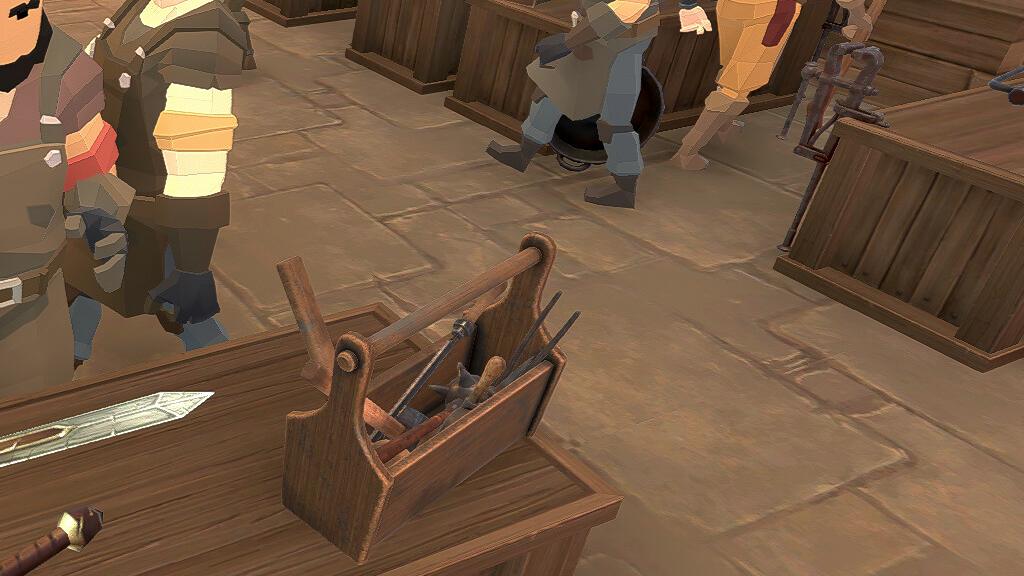
Fill all three order slots every day, complete 20 orders for the free elite worker, and put your two best items on fully decorated racks by the checkout. Everything else is a multiplier on those two.
Stream 1: merchant orders
Five offers per day land in three slots. A refresh costs 200 gold and doubles with each use, so the first refresh is the only one worth considering, and only when all three offers are for materials you cannot produce.
The blacksmith master best products to sell→ page ranks the strongest options and explains where each one fits.
The real value of orders is not the gold per item. It is the counter: every 20 completed orders grants an elite worker, and elite traits include things like +10% speed for all workers, +10% gold from merchants, and reduced hire refresh caps. Twenty orders is roughly four to seven in-game days at a reasonable pace, so a shop that finishes orders consistently accumulates elite workers faster than one that chases high-value single contracts.
Timed orders appear from day 8. Accepting a 24-hour order for +10% is worth it only when the required ingots are already in the warehouse. Missing costs 20%, which on a 500 gold order is 100 gold, the price of a Water Bucket.
Stream 2: rack sales
The Store node (125 points) turns finished goods into walk-in income. Each display needs a blueprint assigned, a rack with capacity, and 500 gold of lights or decorations to reach its maximum customer count.
Decoration prices: plants 75, banners and curtains 75, chains 200, paintings 500, candle/torch/lamp 100, torch stand 180, candle stand 200. The cheapest way to hit 500 on one display is five plants, or a painting, or two torch stands plus a plant.
A single fully decorated Weapon Rack with a 331 gold Sturdy Shield on it, priced at base, will outsell three bare racks selling 73 gold knives. Customers buy one item per visit and leave through the checkout, so the value per customer is set by the display, not the number of displays.
Stream 3: trade routes
Trade routes are the only source of clay, birch, gold ore and gems, and they cost 10,000 to 400,000 gold to level. They are not an income stream at the start; they are a way to convert excess production into scarce materials.
The Clay Pit is the exception worth planning for: 30 Wide Cooking Pans (157 gold each) become 20 clay, and one clay becomes a pottery item worth 483 gold at base. The route costs 10,000 gold, the Pottery Wheel 1,000 and the Kiln 3,500. That is a 14,500 gold project that turns a steel sink into a 483 gold item, and it pays back in roughly 40 pottery sales.
Stream 4: selling furniture and leftovers
Placed items refund 70% of purchase price. That is not income, it is a mistake tax, but it does mean experiments are cheap: a rack bought for 200 gold costs 60 gold to try. Selling a storage returns its contents to the warehouse, which is the clean way to reorganise without losing ingots.
The wage line
This is where most shops leak gold. Daily wages follow base + coefficient x level:
| Role | Base | Per level | Level 5 cost |
|---|---|---|---|
| Blacksmith | 60 | 12 | 120 |
| Assistant | 47 | 11 | 102 |
| Cashier | 24 | 12 | 84 |
| Lumberjack | 34 | 9 | 79 |
| Miner | 32 | 10 | 82 |
A five-worker shop at level 5 pays around 500 gold per day before materials. Add restock costs and the daily burn can reach 800. Order income at 3 slots and roughly 100 gold average per item is 300-600 per day, so rack sales are not optional at that scale. Either the racks carry the difference or the shop is overstaffed.
The safe ratio: one blacksmith per 1.5 order slots, one assistant per two blacksmiths, one cashier per checkout counter, and no lumberjack until an Oak Forest exists.
Mastery nodes that pay for themselves
| Node | Points | Saving |
|---|---|---|
| Discounted Wood | 30 | Cheaper oak restock, matters once Carpentry runs |
| Discounted Ingots | 75 | Direct cut to the 30 gold iron ingot restock |
| Discounted Ores | 200 | Cuts the 15 gold ore restock, best with two mines |
| More Offers | 130 | Fourth and fifth offers per day, more order choice |
| Extra Cart | 100 | More warehouse throughput per trip |
| Trade Routes | 700 | Opens the four material routes |
Discounted Ingots is the first cost node most shops should buy, because iron ingots are the input you purchase most often in the first fifty days. Discounted Ores only wins after an iron mine and a smelter are running, since before that you are not buying ore at all.
A worked day at day 40
Three blacksmiths (level 3, 96 each), one assistant (level 2, 69), one cashier (level 1, 36). Wages: 393.
Morning: accept two iron orders and one steel order. The steel order needs two steel ingots; the smelter makes them from stored ore during the night cycle.
Production: the smiths finish the iron orders by midday, then craft four Bludgeons for the rack. The assistant transfers ingots and restocks ore.
Evening: rack sells two Bludgeons at 85 and one shield at 331. Order income 480, rack income 501. Total 981 against 393 wages and roughly 120 in restock costs. Net around 468 for the day.
That is a healthy day. A day where the order slots sit empty and the racks are bare nets negative, which is why the first fix for a broke shop is always order volume, not price changes.
Official source: Hooded Horse wiki: Workers ↗ — wage formulas and level thresholds. Official source: Hooded Horse wiki: Shop ↗ — decoration and restock prices. Official source: Hooded Horse wiki: Trade routes ↗ — route costs and payouts.
FAQ
How do I make money fast at the start? Fill all three order slots daily, craft Bludgeons when there is no order, and do not refresh offers or hire a third smith before day 15.
Is raising prices worth it? Yes, but in small steps. Purchase chance falls as price rises; a 10-15% markup on a high-quality display item usually nets more than the lost customers.
What is the biggest money sink? Wages on underused workers, followed by restocking iron ingots at 30 gold instead of mining ore.